Two platforms dominate the AI avatar video space in 2026: HeyGen and D-ID. Both let you create talking-head videos with AI presenters. Both eliminate the camera. Both have enterprise customers. But after testing both platforms extensively, the differences are significant enough that choosing the wrong one is a real workflow mistake.
This comparison covers everything that matters — avatar realism, video translation, pricing, feature depth, and who each platform actually serves best.
What Is HeyGen?
HeyGen is a Los Angeles-based AI video platform founded in 2020. Its core product: generate studio-quality presenter videos using AI avatars and synthesized voices, with no camera or filming required. In 2026, HeyGen is best known for Avatar IV (its most realistic avatar model), video translation with lip-sync in 175+ languages, and Video Agent — a workflow automation feature that no competitor has matched.
HeyGen serves a broad market: individual content creators on the $29/mo Creator plan, agencies and marketing teams on Pro, and enterprise organizations on Business plans with SSO, brand kits, and team collaboration tools.
What Is D-ID?
D-ID is an Israeli AI company founded in 2017, originally focused on privacy technology before pivoting to AI video generation. Its flagship product, Creative Reality Studio, lets users animate still photos and generate talking-head videos using AI avatars. D-ID has positioned itself strongly in the enterprise and developer market, offering a robust API for embedding AI video generation into third-party applications.
D-ID’s target audience skews more technical and enterprise-focused than HeyGen. Its API-first approach makes it a common choice for companies building AI-powered video features into their own products, not just creating content directly.
Feature Comparison: HeyGen vs D-ID
Avatar Realism: A Genuine Gap
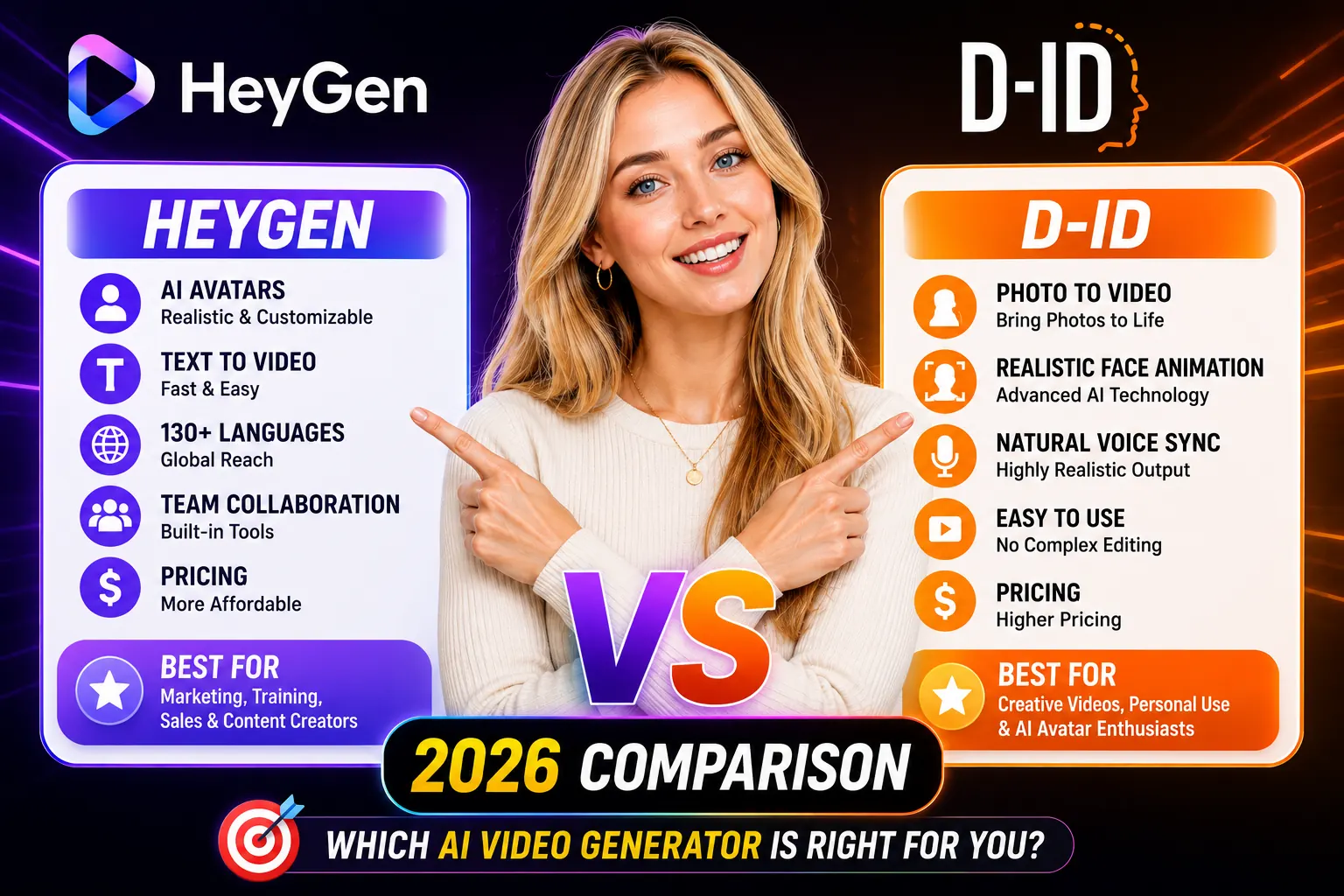
This is the most important differentiator for most users, and HeyGen leads clearly. Avatar IV produces full-body motion, micro-expressions, natural head movements, and hand gestures that respond to emotional cues in the script. The result is a presenter that is genuinely difficult to distinguish from real footage in controlled settings.
D-ID’s avatars are strong — particularly for the photo-animation use case, where D-ID is the category leader. Animating a still portrait photo into a talking video is D-ID’s signature capability and it does this better than any competitor including HeyGen. But for full AI avatar videos with body motion and realistic gesture, HeyGen’s Avatar IV is visibly ahead.
Video Translation: HeyGen’s Biggest Advantage
HeyGen’s video translation with accurate lip-sync is the feature D-ID simply cannot match in 2026. Upload any existing video and HeyGen converts the audio to any of 175+ languages while resynchronizing the avatar’s lip movements to the new dialogue. The result sounds and looks like the presenter delivered the content natively in that language.
For content creators, marketers, and agencies targeting international audiences, this single feature can multiply output significantly. One video becomes five, ten, or twenty language versions without re-recording anything.
D-ID offers some translation capabilities, but the lip-sync accuracy and language breadth do not approach HeyGen’s implementation. If video translation is important to your workflow, this is not a close comparison.
API and Developer Features: D-ID’s Strength
D-ID’s API is more mature, better documented, and more developer-friendly than HeyGen’s. Companies building AI-generated video into their own applications — SaaS platforms, educational tools, customer communication systems — find D-ID’s API easier to integrate and more cost-predictable at scale.
HeyGen offers API access on Business plans, but it is primarily a direct-use platform rather than an infrastructure play. If you are building a product on top of AI video generation, D-ID is the more suitable infrastructure choice.
Pricing: HeyGen vs D-ID
HeyGen Pricing (2026)
- Free: $0 — 3 videos/mo, 720p, watermarked, 30+ languages
- Creator: $29/mo ($24/mo annual) — unlimited avatar videos, 200 Premium Credits, 1080p, voice cloning, 175+ languages, 1 custom avatar
- Pro: $99/mo ($79/mo annual) — more credits, advanced features
- Business: $149/mo + $20/seat — 4K, SSO, API, brand kits
D-ID Pricing (2026)
- Free: 5 videos/trial (not ongoing), limited quality
- Lite: ~$5.90/mo — 10 credits/mo (roughly 10 short videos)
- Pro: ~$29/mo — 65 credits/mo
- Advanced: ~$96/mo — 260 credits/mo
- Enterprise: Custom pricing with dedicated support and API
D-ID uses a credit model throughout. At $29/mo Pro, you get 65 credits — roughly 65 minutes of video. HeyGen’s Creator plan at the same price includes unlimited standard avatar videos with 200 Premium Credits for Avatar IV use. For most content creators, HeyGen’s model delivers more output per dollar.
Use Case Fit: Who Should Choose What
HeyGen Pros and Cons
- Pro: Best-in-class video translation with real lip-sync
- Pro: Avatar IV — most realistic AI presenter available
- Pro: Unlimited videos on Creator plan ($29/mo)
- Pro: Video Agent — unique workflow automation
- Con: 200 Premium Credits/mo limits Avatar IV usage
- Con: API access locked to Business plan
- Con: No still-photo animation feature
D-ID Pros and Cons
- Pro: Best photo-to-video animation in the market
- Pro: Developer-friendly API, mature documentation
- Pro: Available on API from entry-level plans
- Con: Credit model is restrictive at lower price points
- Con: Smaller stock avatar library (100+ vs 700+)
- Con: Video translation and lip-sync significantly weaker than HeyGen
Verdict: HeyGen vs D-ID 2026
For content creators, marketers, and teams creating video at scale without filming, HeyGen wins clearly. The combination of Avatar IV realism, unlimited video output on Creator, and best-in-class translation makes it the right all-around platform for the overwhelming majority of use cases.
Choose D-ID if you need to animate still photos, or if you are a developer building AI video generation into your own product via API. D-ID’s infrastructure-level approach is genuinely superior for those use cases.
The free plan removes all risk from testing. Start there, see the Avatar IV quality, and decide from experience rather than feature lists.
Frequently Asked Questions
Is HeyGen better than D-ID?
For direct content creation, yes. HeyGen’s Avatar IV realism and video translation lead the market. D-ID is better for photo animation and API-based product development.
Which is cheaper — HeyGen or D-ID?
At equivalent price points ($29/mo), HeyGen delivers unlimited standard avatar videos while D-ID gives 65 credits. HeyGen offers more content output per dollar for most creators.
Can D-ID do video translation like HeyGen?
D-ID has some translation features, but HeyGen’s video translation with lip-sync across 175+ languages is significantly more accurate and comprehensive.
Does HeyGen have an API?
Yes, but API access requires the Business plan. For developer use cases, D-ID’s API is more accessible and better documented at lower price tiers.
Does D-ID have a free plan?
D-ID offers a trial with 5 free videos, not an ongoing free plan. HeyGen’s free plan gives 3 videos per month indefinitely with no credit card required.