

The basic version of Leonardo AI is available for free, although it comes with a daily limit of 150 tokens. For those who need more capabilities and fewer restrictions, premium plans start at $10 per month. However, the free version is sufficient for most beginners. It is recommended to try the free version before opting for the paid one. Here is your guide to creating images with Leonardo AI.
Here are 5 steps to get started with Leonardo AI:
Start:
Go to the Leonardo AI App:
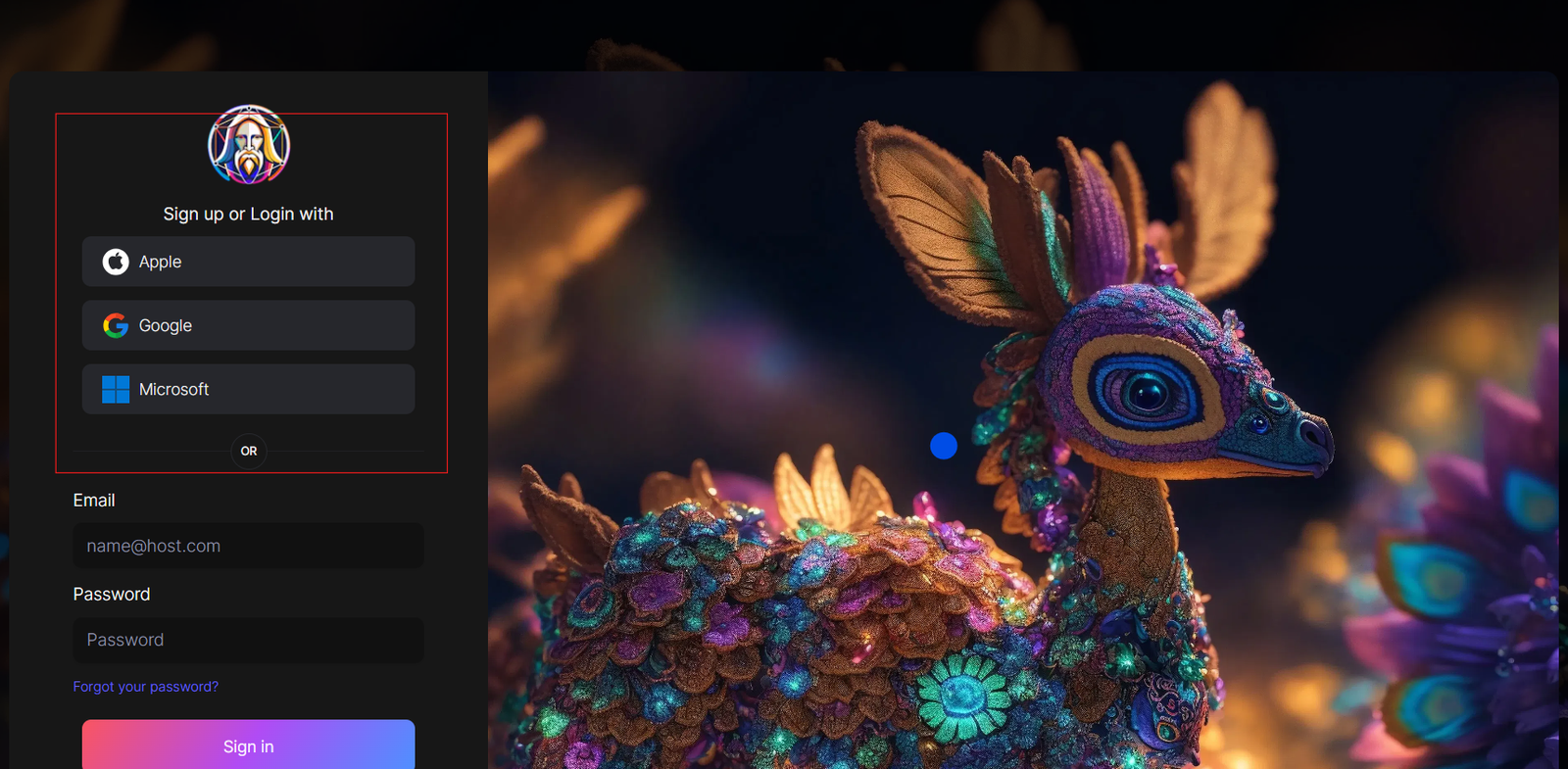
You can sign in with your Apple, Google, Microsoft account, or email account. Then, sign in with your newly created account.
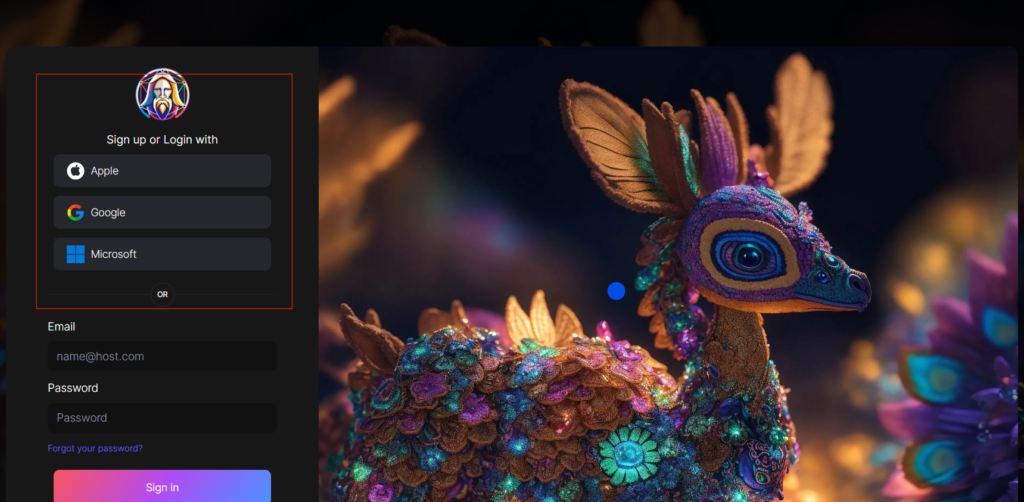
Navigate to the image creation tool
On the app.leonardo.ai homepage, select the ‘Image Generation’ option from the left panel, click on the icon in the middle or use the ‘Image Creation’ button located in the middle
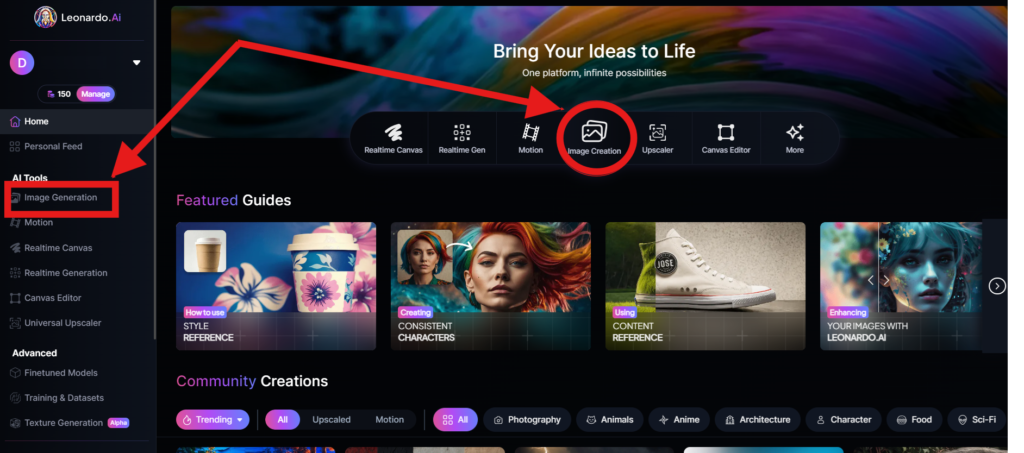
Create your first image
In the prompt field at the top you can immediately create your desired Image. Or you can also create a reminder with the available AI suggestions in 2 ways:
+ Generate a random photo: 1, Click to “New Random Prompt” then 2. click Generate
+ Create a photo with an AI description by an image that you want to get the original idea. Then you edit according to your creativity
Wait about 20 seconds for Leonardo AI to generate the images, and you will receive four stunning high-resolution images as follows:
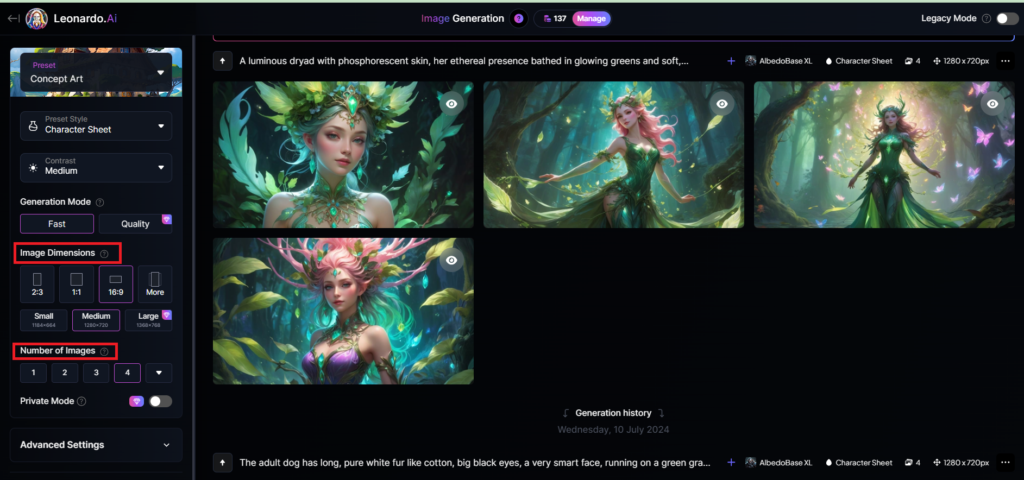
You can select the image size in the “Image Dimensions” section, which includes sizes like 2:3, 1:1, 16:9, and more options under “More” on the left. Alternatively, you can choose the number of images in the “Number of Images” section, with a maximum of 8 images that can be generated.
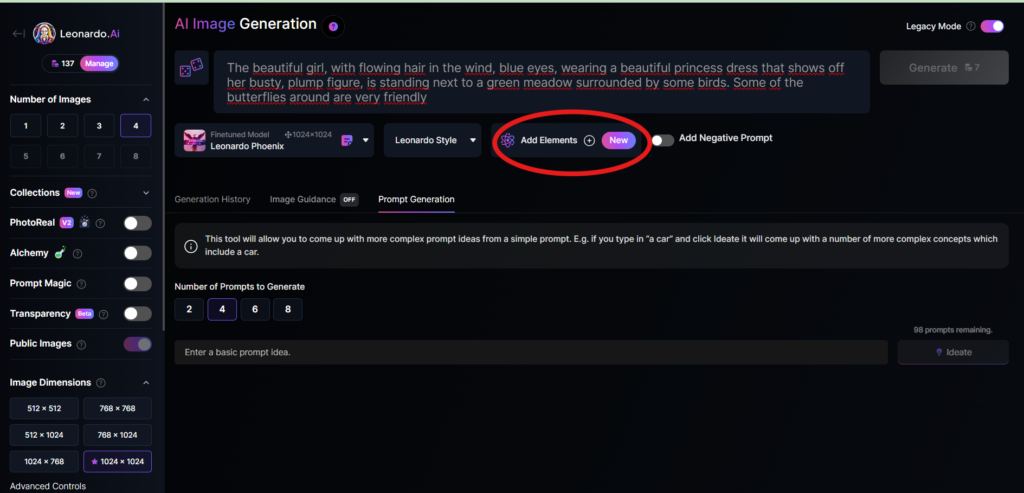
Add Elements
Use the drop-down menu under “Add Elements” to select a specific element such as Coloring Book, Folk Art Illustration, Children’s Illustration, Cartoon & Anime, or Classic Style Christmas Illustration. Although you can select multiple elements, Leonardo advises that choosing more than two elements may lead to unpredictable results.
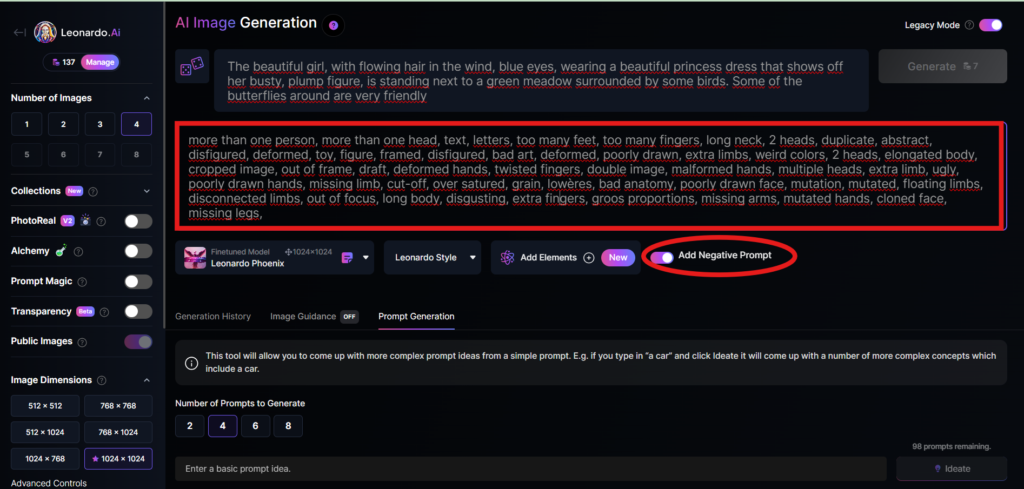
Add a negative prompt
As in the example above, I created negative prompts to ensure the resulting images were error-free, including: “more than one person, more than one head, text, letters, too many feet, too many fingers, long neck, 2 heads, duplicate, abstract, disfigured, deformed, toy, figure, framed, disfigured, bad art, deformed, poorly drawn, extra limbs, weird colors, 2 heads, elongated body, cropped image, out of frame, draft, deformed hands, twisted fingers, double image, malformed hands, multiple heads, extra limb, ugly, poorly drawn hands, missing limb, cut-off, over satured, grain, lowères, bad anatomy, poorly drawn face, mutation, mutated, floating limbs, disconnected limbs, out of focus, long body, disgusting, extra fingers, groos proportions, missing arms, mutated hands, cloned face, missing legs,”
Here are the basic steps for new users to create a simple image with Leonardo AI. In the next article, I will guide you through advanced details to create various types of images for different purposes. You can start your free trial with Leonardo AI here:


Hi there, You have performed an incredible job. I’ll definitely digg it and in my opinion recommend to my friends. I am confident they’ll be benefited from this website.
Puede brindar un efecto de rostro más estilizado con cita Les Corts .
An outstanding share! I have just forwarded this onto a friend who had
been doing a little research on this. And
he actually bought me dinner because I discovered it for him…
lol. So let me reword this…. Thanks for the meal!!
But yeah, thanks for spending some time to discuss this matter here on your blog.
https://www.he198.com/home.php?mod=space&uid=16024
Thanks for the valuable article. More at marcos y perfiles de aluminio .
I enjoyed this read. For more, visit custom kitchen remodeling company .
강남유흥 비매너 피하는 법 유용했어요. 추가 팁은 강남 쩜오 이용방법 로!
Many families overlook the social component of ADL assistance. In small homes, that one-on-one time naturally turns into conversation and connection, something senior care really values.
Appreciate the thorough write-up. Find more at basement moisture waterproofing .
This was very beneficial. For more, visit residential glazing Wembley .
I appreciated this article. For more, visit trusted Nottingham house removals .
Te ayuda a preguntar cuánto tiempo tardan en notarse los efectos habituales: tratamiento drenaje manual Les Corts
This is a solid overview of when wandering, aggression, or severe confusion may signal a need to move from assisted living to memory care. We talk about those red flags on memory care near me .
Your section on secure environments in memory care vs more open layouts in assisted living is especially helpful. More tips on evaluating security measures can be found on senior living .
When there are fewer residents, caregivers can spend more time helping seniors maintain independence instead of rushing through ADL tasks. senior living seems like a good example of this approach.
Your advice to photograph valuables is smart. I keep records in deep house cleaning Sarasota messages.
Veropharm! online pharmacy for regular medications excellent site.
https://forum.iccfish.com/space-uid-50702.html
Check that balance weights are welded cleanly, not just glued; I ask for photos as custom U bolts suggests.
Maintenance staff scheduling was easy with individual restroom ’s service interval guide.